

Articles

Velocity Based Training
Most athletes care about momentum or their speed relative to size in their sport. Nearly every successful program wants to improve speed and repeated speed, so weight training is only a part of that formula. Since Velocity Based Training is a sub-component of weight training, it’s more important to evaluate the speed of the body versus the speed of the bar.
3 Great Uses for a Laser Timer
The best assistant coach a track coach can have is an electronic timer. An electronic timer doesn't lie or, cheat. He makes athletes and coaches deal with reality. He tracks athletes’ progress. He motivates without talking. He solves team problems.

Why Athletes Should Not Be Hand Timed For Speed
Hand times are not sufficiently accurate to measure short sprints such as the 40 yard dash. Instead, electronic timing should be used to increase the accuracy of the results.

What is Electronic Timing Really?
A review of hand time, electronic timing, fully automatic time, laser timers, and new technologies.
Teaching Science and Coaching Sprinters
Coach Holler discusses sprint training in the context of human energy systems.

5 Criteria for Using Speed Training Devices
When selecting speed training devices for use in a sprint program coaches should consider cost benefit, their knowledge of the device and its application, the potential for injury, workflow efficiency, and assessment of the effectiveness of the device.

FinishLynx Timing for High School Track and Field Events
Lisle High School purchased a FinishLynx timing system in 2000. In this article, Don discusses the benefits and features of the system as well as their setup and best practices for an efficient track meet workflow.
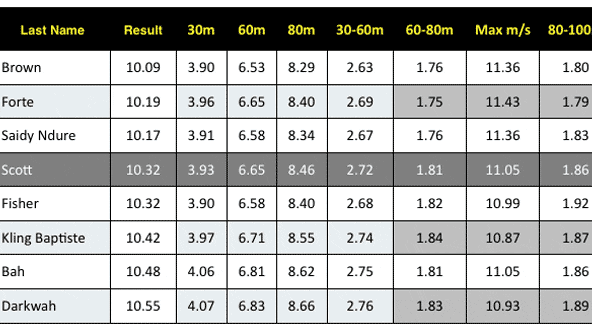
Using Splits and Velocities in the Planning for a 100m Sprinter
In an earlier article, an extensive review was shared to explain the value of 10 meter segments, or splits, to analyze competitive performances. In this article, we will build on those results and explain how an independent 100m performer plans his season.

The Co-opetition Warm-Up
Co-opetition relative to our version of the Dynamic Warm-Up compels athletes to focus on the movements while concentrating on how the group leader chooses to execute them. They must be prepared to change speeds and direction based what the leader chooses to do. We have found that this focus on mirroring the movements and mechanics of the lead runner—or the runner right in front of them—is a better way for athletes to learn the more difficult activities in the series while achieving the much needed competitive arousal prior to a race and workout.

Do Speed Goggles Exist?
“Speed goggles” is a term that describes the increased level of attraction to runners with fast times and impressive results on the track. Many debates can be had over whether it actually makes sense, as well as which factors bring speed goggles into being. Ultimately, the aesthetic effect of running on attractiveness is subjective, but the psychologically positive effects of working hard to succeed are undeniable.
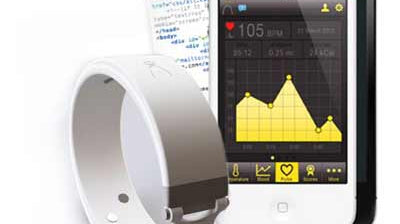
Recovery and Technology: Dr. Yvonne Cagle Interview
The challenges astronauts experience are extreme and mirror what elite athletes must face and recovery technologies are similar. Dr. Yvonne Cagle is currently assigned to Johnson Space Center's Space and Life Sciences Directorate and responds to questions about astronaut recovery, galvanic skin response measurement, monitoring travel stress, and space age technology and medical sources for recovery.

Gurus, Gadgets, and Gimmicks: 6 Dirty Online Tricks to Watch Out For
Information, be it online, print, or verbal, must be taken with a grain of salt. As more and more education becomes available, you must develop a filter that allows you to know which is the truth and what is merely hype in order to combat misinformation.
