

Articles

A Farewell to Arms? The Debate Over Arm Swing Mechanics in Sprinting
No other issue regarding technique and mechanics for enhancing speed remains as controversial as the contribution of arm swing to faster sprinting. Even the world’s top coaches and researchers have different opinions on this issue.

By Leaps and Bounds: My Evolution to the Split Jump
My athletes used a 1970s-era isokinetic device called the Leaper as a rack for their warmups. It didn’t offer enough progressive challenges. Split jumps solve that problem. There are several variations to keep interest high.

Coaching the Twixter: How the 800 Became a Sprint Event
Solid research suggests that the training modality for the 800 as “middle distance” is erroneous. Many experts now regard the event as a long sprint. As such, the key is developing the ability to reduce the falloff in speed as much as possible.

A Coach’s Evolution to the “Load Six” Philosophy
Much of what was once considered gospel in coaching sprinters has been subject to revision or even outright abandonment in recent years. Other concepts, however, have come full circle—acceptance, rejection, reacceptance. It is important to keep an open mind in evaluating everything—or “load six” in the parlance of the Old West. That is, less absolute certainty and more willingness to consider the viewpoints of other coaches with whom we share the game goal: faster, more powerful runners.

Should We Ignore the Psycho-social Aspect of Competitive Athletics?
As we look at the bio-psycho-social approach to training high school athletes, “psycho” and “social” may be as equally important as “bio.” So-called “fluff” in programs is often part of a firm foundation along with the most advanced technical knowledge. Some may call it a placebo, but it’s hard to ignore the positive results it achieves.

Analyzing 3 Key Concepts in Tony Holler’s Creation of a Sprint Culture
Illinois Hall of Fame coach Tony Holler lays down the law as he sees it in his quest to promote sprinting. Periodization is one of his targets. He says there are just two seasons: football and track.

Why Do We Turn Left on a Track?
I often tell my athletes that track running is a lot like NASCAR—run fast, turn left, repeat as necessary. But why do we turn left on a track? The question may well be related to why we turn left in a lot of activities.

Applying Science to Speed Training
This article highlights Ken Jakalski's evolution to the Weyand/Bundle Speed Regression Algorithm in his efforts to provide guess-free time and distance goals for individual bouts of high speed sprinting. The author analyzes how his journey began in the mid 70's when he first experimented with the evaluation indicators Russian coach Valentin Petrovski developed in training Valeri Borzov, the 1972 Olympic Champion in the 100 and 200 meter dash. While Petrovki's projections were based on the actual performances of Soviet and foreign sprinters and adjusted over time, the Bundle/Weyand algorithm is based on extensive research revealing how the performance duration curve in sprinting is due to force impairment. It can predict high speed running performances with 97% accuracy.

5 Criteria for Using Speed Training Devices
When selecting speed training devices for use in a sprint program coaches should consider cost benefit, their knowledge of the device and its application, the potential for injury, workflow efficiency, and assessment of the effectiveness of the device.

The Co-opetition Warm-Up
Co-opetition relative to our version of the Dynamic Warm-Up compels athletes to focus on the movements while concentrating on how the group leader chooses to execute them. They must be prepared to change speeds and direction based what the leader chooses to do. We have found that this focus on mirroring the movements and mechanics of the lead runner—or the runner right in front of them—is a better way for athletes to learn the more difficult activities in the series while achieving the much needed competitive arousal prior to a race and workout.

High-Speed Sprinting Is a Horse of a Different Color
New research out of the SMU lab has now given us a much clearer idea of what should be taught. And what is even more interesting is that these mechanics are not anything new. These reflect some of my thinking relative to human and animal locomotion going back to 2001. However, as Dr. Mike Young notes, “Sprinting is an extremely complex motor task involving repeated rapid “switching on and off” of practically every muscle in the body.”
One Simple Strategy for High-Speed Running
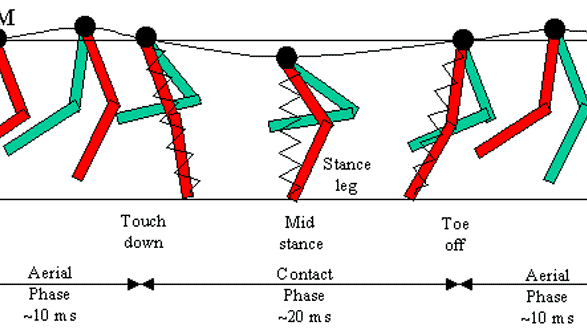
At his recent Speed Summit presentations in Lisle, Illinois, SMU’s Dr. Peter Weyand discussed the implications of the SMU lab group’s latest papers, “Foot speed, foot-strike and footwear: linking gait mechanics and running ground reaction forces” and “Are running speeds maximized with simple-spring stance mechanics?” In the second paper, Ken Clark, Laurence Ryan and, Weyand hypothesized that a passive, linear-spring model, long regarded as the means by which runners optimize force production and economy, would not apply to the mechanics that maximize the ground forces essential to high speed running.
